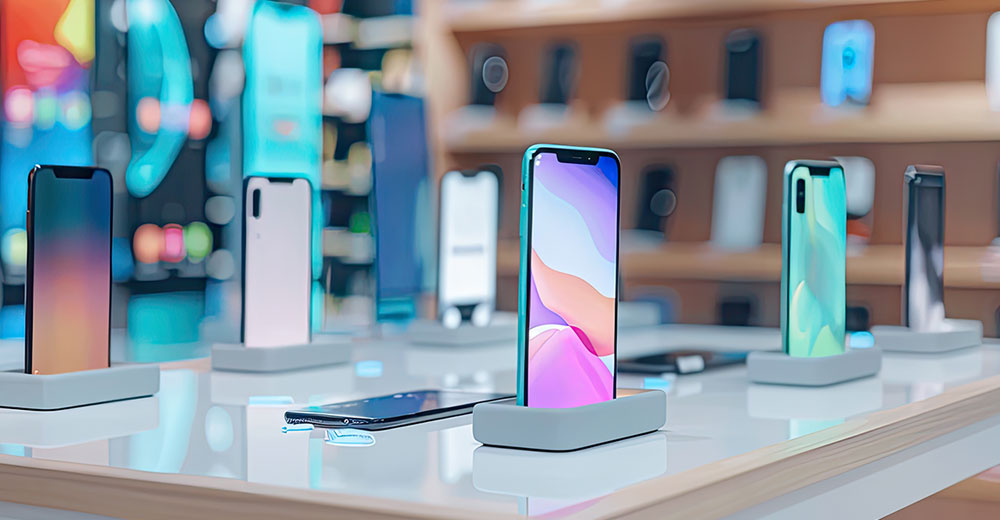
Polarization is everywhere these days, even in the smartphone market.
According to Omdia analyst Justy Hong, runaway memory prices are polarizing the global smartphone market, stifling demand for budget smartphones.
"To cope with severe cost pressures, smartphone vendors are scaling back low-end lineups and shifting their focus to mid- and high-end segments," he wrote in a company blog.
For premium models, where consumers are less sensitive to price hikes, smartphone vendors continue to upgrade performance and specifications despite soaring material costs, he added.
He predicted smartphone shipments in 2026 will decline 12% from 2025 levels.
"For big phone makers, their biggest profit margins come from the high end of their portfolio, so it's easier for them to absorb the skyrocketing cost of memory there," said Ross Rubin, the principal analyst at Reticle Research, a consumer technology advisory firm in New York City.
"They can also raise prices if need be because many of their premium customers are less price sensitive," he told TechNewsWorld.
However, he pointed out that even big phone makers are having trouble competing with big AI. "Apple and Samsung used to be just competing with other phone and PC makers," he explained. "So they had a big size advantage there, but now that they're competing with these AI hyperscalers and data centers, who are willing to pay, in some cases, multiples of what the going price for memory had been."
Razor Thin Margins
William Kerwin, a senior equity analyst with Morningstar Research Services in Chicago, explained that memory makes up a higher proportion of the cost of making lower-cost phones, which means memory cost inflation has a disproportionate impact on margins.
"For a premium phone like an iPhone, other components are more expensive, and memory has been historically less than 10% of the total build cost," he told TechNewsWorld.
"Flagship buyers are already trained to pay premium prices, but every extra dollar in memory costs forces budget phone makers into painful tradeoffs," added Mark N. Vena, president and principal analyst of SmartTech Research, a technology advisory firm in Las Vegas.
"That’s because their margins are razor thin and consumers in that segment are far more price sensitive," he told TechNewsWorld.

Budget smartphones bear the brunt of rising memory prices, asserted Rob Enderle, president and principal analyst of the Enderle Group, an advisory services firm in Bend, Ore.
"In sub-$400 smartphones, memory now accounts for nearly 60% of the total Bill of Materials (BOM), soaring past 64% in sub-$99 devices," he told TechNewsWorld. "Because budget phones are already engineered to the tightest possible margins, manufacturers have no 'fat to trim' when component costs spike."
"Conversely," he added, "premium phones have more margin flexibility and can offset memory hikes by adjusting other high-end components, such as utilizing previous-generation system-on-a-chip (SoC) processors or swapping display types."
Downsized Experience
Enderle noted that rising DRAM and NAND prices are forcing compromises in the performance and specifications of budget and mid-range phones entering the market.
"To cope with the financial strain without raising retail prices beyond what price-sensitive buyers can afford, vendors are actively freezing memory capacities at previous-generation levels," he said. "Some are eliminating higher-capacity variants entirely from their lower-tier lineups."
"Manufacturers are also making technical compromises elsewhere, such as dropping redundant macro lenses or reverting to smaller image sensors to offset the memory premiums," he added.
For the end user, higher memory prices translate to a noticeably downgraded experience, he continued. "Lower DRAM limits multitasking and the device's ability to run resource-heavy applications smoothly, while reduced NAND storage leaves less room for photos, videos, and system updates," he explained.
"Ultimately, consumers are paying the same, or more, for less advanced hardware," he maintained, "leading many to hold onto their current devices longer or turn to the second-hand market to get premium specifications at a budget price."
Vena agreed that many manufacturers will focus on protecting retail prices rather than simply adding more RAM, faster storage, or bigger capacities. "This means innovation in the budget segment will slow down, but flagship devices will continue to push forward," he said.
"Consumers will feel the impact of higher memory prices every day with slower multitasking, more aggressive app reloads, diminished AI capabilities, and less room for photos, videos, and downloaded content," he observed.
"Ironically," he added, "those who try to save money may have to replace their phones sooner as the experience degrades faster."
Squeezed by AI
Vena explained that memory is now one of the most strategic components in a smartphone, partly because it affects not only storage but also how well AI experiences perform on the device.
"Companies that can lock in long-term memory supply agreements or design more memory-efficient software will have a meaningful competitive advantage as competitors battle costs, performance, and profitability," he said.
Morningstar's Kerwin concurred that long-term memory agreements are becoming increasingly important. "Not only are prices going up, but it's hard to get supply," he explained. "Smartphone makers like Apple are now entering agreements to guarantee supply over a longer term but are likely accepting higher prices as a result."
Enderle added that the root cause of the smartphone squeeze isn't mobile demand — it's the artificial intelligence boom.
"AI data center construction is straining the exact same supply chains that feed mobile and PC manufacturing," he explained. "This is forcing a structural shift in the smartphone industry. Brands that spent the last decade chasing pure volume in emerging markets are now pivoting to chase value in the premium tiers."
"Additionally," he continued, "this pricing pressure is a massive boon to the refurbished device sector, with the global trade in pre-owned smartphones expected to grow by 12% this year as consumers seek viable alternatives to hollowed-out budget models."
Ecosystems, Not Devices
Rising DRAM costs are one of several factors increasing the cost of developing next-generation connected devices, observed Elizabeth Parks, president and CMO of Parks Associates, a Dallas-based market research and consulting company specializing in consumer technology products.
"As manufacturers invest in AI capabilities, advanced memory, and more powerful computing platforms, those costs influence retail pricing," she told TechNewsWorld.
"Our research consistently shows consumers are willing to pay more when they clearly understand the value they receive, whether through better performance, greater reliability, or intelligent features that improve the overall user experience," she said.
"The next phase of consumer technology growth will be driven by ecosystems, not individual device sales," she predicted. "The companies that win will be those that make hardware, software, services, AI, and daily use cases work together in ways that feel useful, easy, and trusted."